Target Item Space
Role
Senior User Experience Design Manager
Team Size
8 USER EXPERIENCE DESIGNERS: 8-18 YEARS EXPERIENCE
Status
ON GOING
Overview
Orchestrating the strategic design and architectural replatforming of the end-to-end ecosystem that powers how merchandise is created, enriched, managed, and activated across all Target and partner experiences.
Starting point
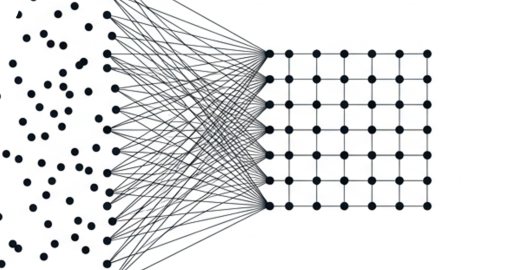
Resolving the Item Space operational crisis by replacing disjointed legacy applications with an intelligent, composable Micro Frontend
Project Context & Business Challenge
The scale of operations at Target requires a technological infrastructure capable of handling massive throughput with zero tolerance for systemic failure. The Enterprise Item Space is the foundational ecosystem that dictates how every single product moves from a mere concept into a physical store or digital cart. Our North Star was clear: to deliver a single, intelligent item experience that is scalable, composable, inclusive, and effortless for Target internal teams, our external partners, and ultimately, our guests everywhere.
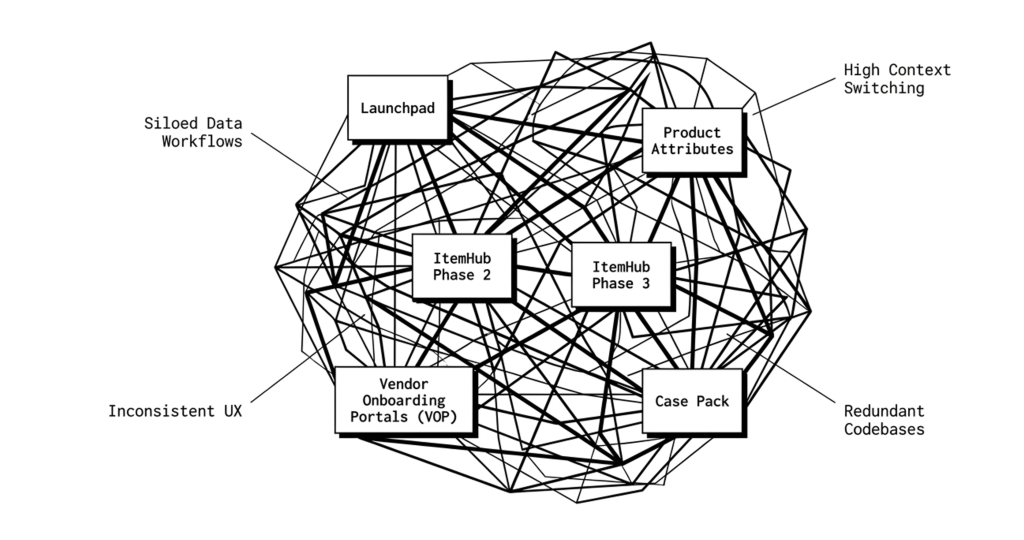
However, the reality of our current legacy systems was characterized by extreme operational friction. The ecosystem was powerful but fundamentally siloed. We were operating multiple parallel applications—including Launchpad, ItemHub, Vendor Onboarding Portals, and various content management tools—that forced our teams into disjointed workflows. The business challenge was stark: data inconsistencies were rampant, duplication of effort was the norm, and scaling the system to meet modern retail demands required navigating immense technical debt. The cost of this complexity was manifesting as slower delivery cycles, increased operational costs, and highly inconsistent partner experiences.
The Problem Statement
How might we systematically dismantle a fractured, legacy enterprise architecture and replace it with a unified, intelligent platform—without disrupting the daily operations of a global retail supply chain?
The core problem extended far beyond surface-level user interface design; it was a crisis of cognitive load and workflow fragmentation. Our internal teams required deep, specialized domain knowledge simply to navigate the disparate tools required to onboard a single product. The high context switching between ingestion, mapping, validation, and activation interfaces was creating unacceptable bottlenecks. We needed to design a transitional bridge that could migrate, reimagine, and consolidate these fractured capabilities into a scalable micro-frontend architecture, fundamentally lowering the cost to operate while improving data hygiene.
The legacy architecture created a powerful ecosystem that was inherently limited, weighed down by significant technical debt and lack of cohesion.
Role & Leadership Contribution
As the Senior User Experience Manager for the Target Enterprise Item Space, managing a team of 8 designers, I owned the overarching design strategy and experiential vision for this massive digital transformation. My mandate was to humanize the complex technological replatforming, ensuring that the architecture served the human operators rather than the reverse.
Operating in an environment categorized by "Very High" collaboration intensity, my leadership was heavily anchored in stakeholder alignment and cross-functional facilitation. I orchestrated a multifaceted team of product designers and researchers across more than sixty active user experience touchpoints. By employing an adaptive, servant-leadership philosophy, I focused on building a resilient "learning machine" within the team—coaching designers to navigate the profound ambiguity of data modeling, taxonomy restructuring, and micro-frontend composability, while aligning directly with multiple product owners and engineering leads in parallel.
Product & Design Strategy
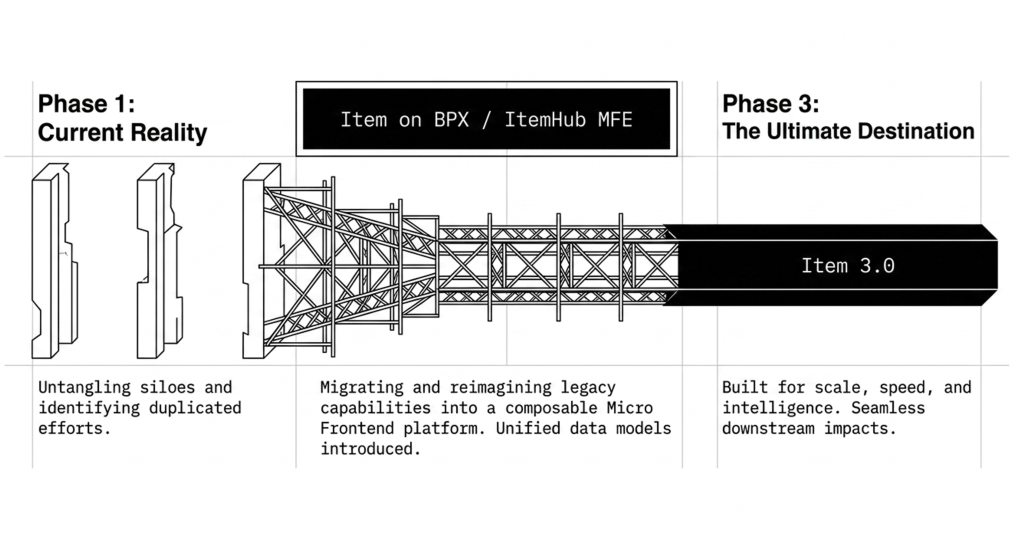
The strategic vision required a meticulously phased approach, as a sudden total system replacement presented an unacceptable operational risk. Our design strategy was divided into navigating the Transitional Platform and defining the Future Platform (Item 3.0).
During the transitional phase, the strategy focused on consolidation. We designed a composable Micro Frontend (MFE) ecosystem on our internal platform (BPX), which allowed us to establish a unified data model and a shared design system. The user experience strategy here was to centralize common workflows and implement unified search and insights, effectively shielding the end-user from the underlying migration of legacy APIs.
For the Future Platform, the strategy shifted toward Intelligent Automation and an Agentic AI framework. By designing end-to-end, composable experiences driven by AI-powered insights, we positioned the system to autonomously handle routine data normalization, elevating the human user's role from data entry to strategic exception handling and governance.
Research & Discovery Approach
To comprehend a system engaging over forty distinct teams, our discovery approach had to be exhaustive and deeply systematic. We mapped the ecosystem across five distinct vectors of complexity to ensure our design interventions were targeted correctly:
Domain & System Complexity: Mapping the dependencies of legacy applications, hybrid architectures, and outdated technology debt.
Organizational Complexity: Navigating roadmaps across product management, engineering pods, business process operators, and external supplier teams.
Business & Workflow Complexity: Charting the end-to-end journey from item initiation and creation, through validation, review, activation, and eventual downstream consumption.
User & Terminology Complexity: Reconciling the fractured taxonomy where "business," "product," "engineering," and "partner" stakeholders utilized entirely different vernaculars for identical concepts.
Through hundreds of parallel workshops and discovery sessions, we established a baseline understanding of the cognitive toll exacted by the legacy system, identifying the precise points where intelligent automation would yield the highest return on investment.
Design Process & Decision-Making
The design process was governed by a rigorous operational cadence. We established a continuous pipeline that moved from intake and triage, through deep working sessions, into layered design, product, and engineering reviews.
A critical design decision was the mandate to standardize UI patterns and components across all micro-frontends. Historically, each legacy application utilized bespoke interfaces, forcing users to relearn interactions. By enforcing a shared design system, we drastically reduced the cognitive load required for context switching. Furthermore, we had to make complex decisions regarding data modeling and taxonomy attributes. We designed highly dense, analytical interfaces that allowed expert users to view, compare, and bulk-approve AI-generated attribute mapping, ensuring that the interface provided the necessary information density without sacrificing visual clarity.
Team Collaboration & Execution
Executing this transformation required managing an unprecedented volume of concurrent workstreams. At any given moment, the team was balancing legacy support operations alongside future-state visioning, overseeing thirty to forty active initiatives in flight.
I established a cross-functional alignment framework that integrated design directly with business process teams, engineering DevOps, and partner validation groups. This ensured that UX decisions were never made in a vacuum. By facilitating strict governance checkpoints and content reviews, we maintained a unified vision despite the massive scale. We operated under a philosophy of co-creation, where engineering feasibility and user experience desirability were negotiated openly, ensuring that the resulting micro-frontend architecture was both technically resilient and intuitively designed.
The WORK-IN-PROGRESS Solution
The resulting architecture represents a paradigm shift in how Target manages its global catalog. The Item 3.0 Platform is a secure, scalable, and resilient open ecosystem powered by APIs.
The unified interface elegantly masks the complexity of the underlying micro-frontends. Users now interact with a single, intelligent item experience that provides proactive, data-driven insights. Rather than manually routing data through disjointed portals, the system leverages intelligent automation to guide the item lifecycle from ideation to activation. The interface provides composable experiences that adapt to the specific context of the user—whether they are an internal merchandiser, an external vendor, or a data governance specialist—delivering precisely the tools they need within a unified, familiar design language.
Impact, Outcomes & Learnings
The transition toward the Item 3.0 platform yielded transformational business outcomes, fundamentally redefining the return on investment for enterprise UX. By mitigating the root causes of systemic complexity, we achieved a 66% increase in operational efficiency, effectively decoupling our catalog growth from linear human resourcing limits.
Key strategic impacts included a significantly faster time-to-market for new merchandise, drastically higher data quality through automated validation, and a profound reduction in operational costs. We successfully transformed the user experience from one of frustration and redundancy to one that is predictive, proactive, and deeply collaborative.
Key Learning: In massive enterprise ecosystems, the ultimate measure of design success is not mere aesthetic simplification, but the strategic reduction of systemic complexity. True design leadership in this space requires the courage to dismantle legacy structures and the vision to architect scalable systems where human intuition and machine intelligence operate in perfect synergy.